
Seeking Change, Then Making It
Walking with riptide

This week one of my coaching clients (I’ll call her Annie), who is the director of a childcare center, updated me on the work she has been doing in the studio space she created in her center to research more deeply the practices she hopes, over time, to support her staff to take on with more confidence. She told me she was concerned about the way the children were responding to the environment, their lack of deep focus and play, their reluctance to tell stories or engage in discussion with each other. She’s been working sporadically - as she can, in the midst of her other work which is still the absorbing work of a childcare director - with a very small group of children who are turning 5 soon. They come weekly, maybe once or twice, in the afternoon for an hour and explore the provocations she has offered. And they love it. They clamor for the opportunity, ask all the time if this day can be a studio day, and are reluctant to miss a day when they might have a chance to go to the studio.
Annie was feeling frustrated because the children didn’t seem to be doing all the kinds of things that she knows children can do - that she reads about in books, and in documentation she has seen from various other schools and centers. Her images don’t match the images she sees elsewhere. So she was sure she was doing something wrong - and something badly. I invited Annie to turn her attention towards the children’s enthusiasm for their time in the studio. She told me more about a child who hadn’t wanted to stay home when he knew he would miss a chance to be in the studio. She smiled as she told me about his excitement, and she relaxed her shoulders. Let’s start there, I said. Let’s allow the gap you perceive between where you think you’d like to be and where you are now to be a source of challenge and curiosity and hope and imagination and possibility. And let’s focus on what feels really good. Today. Let’s pay attention to what we want to see more of.
I asked her, What do you think is creating the children’s enthusiasm to be in the studio? This she already knew: choice, that Annie was taking their ideas seriously, that she put their work on the wall and asked them to talk about it with each other, novelty, surprise, free exploration. Of course! Don’t we all crave this kind of permission? Don’t we all want to be seen? Annie is just at the beginning of her journey and it is so exciting, so worthy of celebration. In spite of the fact that she didn’t have all the structure and resources she needed, she made this tiny crack in her program and the light is starting to find its way in. She is seeking change and making it.
Annie has invested a lot of time in clarifying her values and working with others to clarify the values of the center. Those values led her decisions to create this studio space and to find the time in her week to work alongside a small group of children there. And now she’ll keep asking: What do I value about what is happening here? What is surprising me? What is confusing me? What new questions do I have? What might I do next?
The Ontario Reggio Association (@ontarioreggio) recently posted this quote from Tiziana Filippini:
“Even if our designing is open and flexible it is based on a forecasting thought endowed with a high conscious intentionality, which we need to set up to orient the activity to come. We are talking about initial choices from many possibilities that can then be modified in progress in function of what will happen and not of predeterminations.”
The words and concepts that stand out to me are: forecasting, high conscious intentionality, orient, initial choices, possibilities, modified, in progress, will happen, not predetermined. All provisional, all expectant of change. All open to the inevitability of the influence of other - other people, other circumstances, other ideas, other unforeseen or magical happenstance.
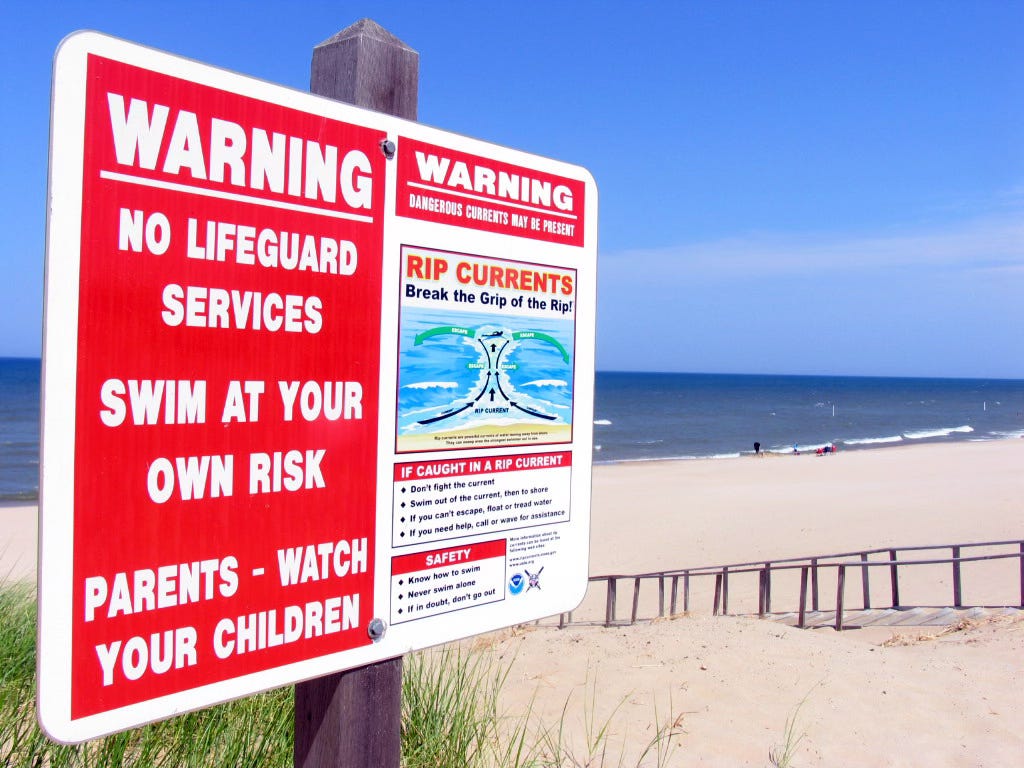
Because this month in The Studio we’re thinking about change - and influenced by adrienne maree brown’s principle of emergence: Change is constant. Be like water.- water has been a consistent metaphor we’ve played with in our writings and weekly meet ups. To be like water is to flow - to be with water is to stay oriented to the activity to come. At yesterday’s meet up, we spent some time considering the experience of riptide. Beachgoers are warned to be wary of the sneaker wave that might pull you into a riptide. It’s the reason we’re cautioned not to turn our back on the ocean. We’re taught to be afraid of the riptide because it might kill us - which is not untrue. I wouldn’t go wandering into one willingly. But I have some sense that what to do if I do get caught in one is not to fight it. That intention orients me to the potential activity to come. And wow, there are a lot of possibilities beyond that, none predetermined.
If not fighting the riptide is what gives us a chance to survive, what might be true about the everyday riptides that have the potential to drag us under?
Fairly often, during the winter months, my weather app lights up with a “beach hazards statement” that typically warns about an increased likelihood of sneaker waves. It’s good to know, I guess, but I try not to let it frighten me away from taking a walk on the sand. The forecasting raises my consciousness and my intentionality to choose to walk by the ocean and orients my attention, not knowing exactly what will happen, ready to modify my choices once my walk is in progress, trying to look forward to the possibilities of my not predetermined experience. I’ll try to practice meeting up with all the constant little changes - the shift in the wind, the sudden rain, the clearing sky, the breaching whale, the wild dog, the chip stealing sea gull, the wedding party, the dead bird, the elk on the dune, the diving pelicans, the perfect sand dollar, the purple sea star. All along the way I can keep asking: What do I value about what is happening here? What is surprising me? What is confusing me? What new questions do I have? What might I do next?
All these constant little changes invite attention and a chance to check in with what we know, what we value, what we notice, and what it makes us wonder. And then we take another step. And then we do it again. And take another. Our fears of being wrong, or doing things wrong, or not doing things right or as well as the person beside you or in some other school are just like the fear of the riptide. We’re afraid we won’t know what to do when we don’t know what to do. We want to know how to do the things we think are good and beautiful. We want to be sure. We want to get it right.
You know, it’s easy now to use AI to create an image that looks like an incredible Reggio-inspired environment that is as impressive as the real thing. Maybe that’s not terrible. Because the replication of those environments and material experiences is not the kind of attention to values and possibility and change that created them in the first place. Not knowing what to do or how to do it is what made the doing possible - it’s what makes it necessary.
Annie already has a strong, thoughtful set of values and a vision inspired by a variety of sources and collaborations. She’s all set to walk on the sand and see what comes - even if (even when) it’s a riptide. She knows what to do next because she’s paying attention to and making sense of what just happened. That’s how we move towards the world we want to make. Keep moving, and making.
Opportunities to work with us:
Playful Inquiry is free to read. Discussion is available to members of The Studio for Playful Inquiry which you can find more about here.
Studio Camp is open for registration. Read more about this special program here.
Leading for Playful Inquiry is open for enrollment.
Susan has two openings for coaching clients beginning in early August. More information here.