
Small Steps
and the sweet taste of strawberries

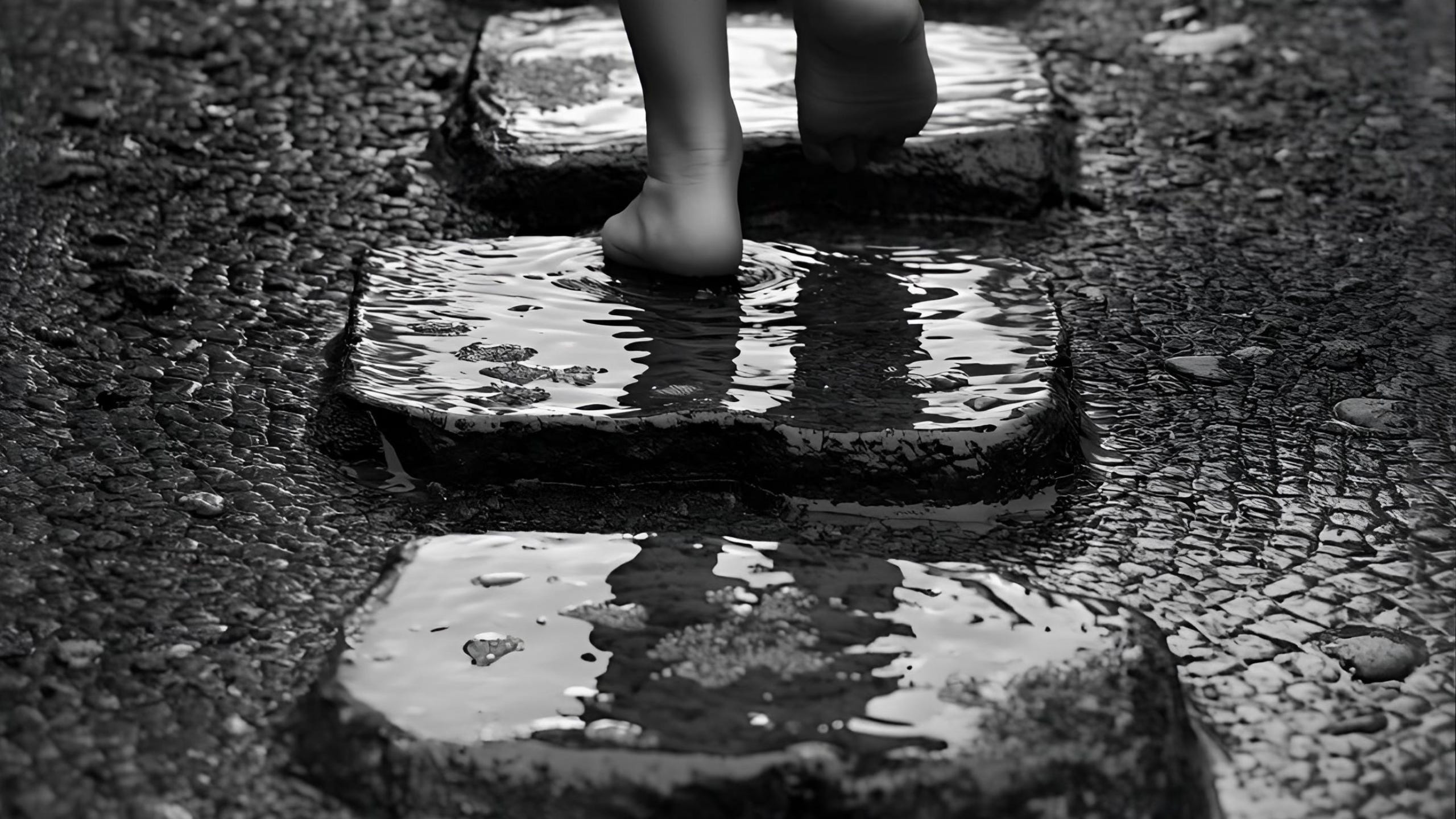
"With attention and intention, we can shape our system in ways that resource the pathways that nourish our well-being (Deb Dana, Anchored, p. 105)."
In July and August in The Studio for Playful Inquiry, we read Anchored and Inciting Joy together as we focused on the practice of finding glimmers - which is Deb Dana’s word for paying attention to the world and our experiences with the intention to perceive what brings us joy, delight, happiness, or comfort. In many ways, our explorations this month are grounded in a similar practice - only this time, we’re focusing on the ways that making a commitment to being aware of glimmers can set us up to find openness and flexibility as we encounter the inevitable challenges inherent in any community. This is true even when some of the members of that community - some of its citizens - are very young.
In Pam Oken-Wright’s new book, Embracing Challenges in Early Childhood Education, which we are reading together in The Studio this month, she writes that young children "have not yet learned that being right can become something to protect at all costs, and it is up to us to make sure they don't. Curiosity is a casualty of the need to be right. In so many ways, we teach children to value correctness over curiosity, over trial and error, over innovation." We are considering this idea, and others that run through her important work - as fractals and properties of emergence that connect small and all. To seek a glimmer is to seek a kind of fractal that is a way to “resource the pathways that nourish our well-being.”
In her book, The Way of Integrity, Martha Beck explains, “Fractals form because of the interplay between the basic shapes and forces that make up the material world (Beck, p. 285).” A glimmer can help us find a new kind of shape that may lead us to meet up with the forces of the world in new ways, creating new patterns. Beck goes on: “Something similar to ‘fractaling’ happens when people change their behavior… The ‘shape’ of your life - your words and actions - will shift in ways that affect the people around you. As those people change, the shift in their lives will affect the people around them. … This is how individuals and small groups may end up influencing huge numbers of people (Beck, p. 286).”
The way that we respond to children when they are in conflict, or make mistakes, or seek to participate and make meaning - has a huge influence on their curiosity, and their creativity, and their sense of belonging. It takes resources to make new small decisions in small moments. And so we need to be developing these resources in ourselves. We need to nourish our own pathway first. We cannot begin to create new patterns if don’t treat ourselves as the first unit in the design.
Beck writes, “The only thing that will keep us from destroying ourselves at a collective level is exactly what keeps us from destroying ourselves at an individual level (Beck, p. 289).” And Deb Dana puts it this way: "Subtle shifts in our autonomic states and our autonomic patterns translate into new stories about who we are and how we navigate the world. We humans are storytellers, meaning-making beings, and it is through our autonomic nervous systems that we first create, and then inhabit, our stories (Dana, p. 123)."
These heady assertions remind me of this wonderful (funny?) poem by Ellen Bass:
Relax by Ellen Bass
Bad things are going to happen.
Your tomatoes will grow a fungus
and your cat will get run over.
Someone will leave the bag with the ice cream
melting in the car and throw
your blue cashmere sweater in the drier.
Your husband will sleep
with a girl your daughter’s age, her breasts spilling
out of her blouse. Or your wife
will remember she’s a lesbian
and leave you for the woman next door. The other cat—
the one you never really liked—will contract a disease
that requires you to pry open its feverish mouth
every four hours. Your parents will die.
No matter how many vitamins you take,
how much Pilates, you’ll lose your keys,
your hair and your memory. If your daughter
doesn’t plug her heart
into every live socket she passes,
you’ll come home to find your son has emptied
the refrigerator, dragged it to the curb,
and called the used appliance store for a pick up—drug money.
There’s a Buddhist story of a woman chased by a tiger.
When she comes to a cliff, she sees a sturdy vine
and climbs half way down. But there’s also a tiger below.
And two mice—one white, one black—scurry out
and begin to gnaw at the vine. At this point
she notices a wild strawberry growing from a crevice.
She looks up, down, at the mice.
Then she eats the strawberry.
So here’s the view, the breeze, the pulse
in your throat. Your wallet will be stolen, you’ll get fat,
slip on the bathroom tiles of a foreign hotel
and crack your hip. You’ll be lonely.
Oh taste how sweet and tart
the red juice is, how the tiny seeds
crunch between your teeth.
What happens when we allow ourselves to focus on the strawberries in our midst? What happens when we are determined to find them? What new stories become possible? What new stories do we make available to others to pick up and carry on as other possible ways of seeing and being in the world?
In Inciting Joy, Ross Gay includes an essay about “covering” in which he remarks: "The cover is perpetual, we are perpetually covering, we are ever citational, it is called thinking, it is called learning, it is called making, it is called being a creature with, it is our only choice. Nonpossessive undeclared citationality, which I'm gonna go out on a limb here and just call life (Gay, p. 134)."
In other words, maybe, small is all. As adrienne maree brown writes, “the large is the reflection of the small.” In this thing we call life, what we transcend always includes what came before. And this is why he points out that "Our tradition of sharing, to the tradition of owning, is treason (Gay, p. 135)." Small is ALL. In our efforts to be right and to stay right, we forget what we’ve covered. We forget that to share is our only option.
Gay writes, "That scarcity, that need for a best or an only, is just a story we keep telling each other, and ourselves. And it's a really bad story." It's a story that is bad for the reasons that Dana explores, and for the reasons that Oken-Wright explores. Scarcity makes us feel disconnected from one another, it makes us too easily convinced that an other exists and therefore might be the enemy, it makes us focus on hoarding rather than on making all the beautiful stuff we possibly can because we absolutely are capable of making enough of what we need to go around. The moment that we start to imagine the possibility, the connection, the abundance, the beauty - we start to feel a shift towards safety in our bodies. We could choose that. We could choose to "trade the podium for the garden, where we practice not hoarding the food and beauty but instead making enough of it to go around (Gay, p. 157)." We could choose to find a new way to be together that does not require anyone to learn to believe their value lies in their rightness.
Gay writes, “When class is not a site of evaluation, but one of mutual bewilderment, encouragement, support, and witness - i.e. unabashed being with; unabashed care - we learn better. And we learn together what we need to learn. One word for which is curiosity, a more loving and useful aspiration or acquisition or practice by far than mastery could ever be (Gay, p. 158)."
What if instead of focusing on what winning feels like, we help children learn what safe feels like? What trust feels like? What love feels like?
I think that's where resistance lives. It's much harder to break someone who knows safety, trust, and love in their bones - who knows on the most primal level that they are deserving of those things. But it's also hard (impossible?) to learn those things when we are not challenged. When do we ever have a better chance of learning safety, trust, and love than when we're in need of protection, encouragement, a hand to hold, a listening ear? Ross Gay writes:
"In this school we wanna make work, and we wanna wonder about it. We wanna note the wonders of what we make, and we wanna wonder about them. What is this thing? How is it working? What is it showing us? How do we listen to it, and learn from it? How does this thing show us how we might try to make a next thing? Wondering together again and again and again like this, an endeavor of unfixing, of dismastery, of community-supported bewilderment, is the practice. Which means as well that the practice of inquiry and unfixing is a practice of changing (Gay, p. 167)."
What small change might you make today to begin creating the pathway toward nourishment and well being?
Discussion on this post is open in The Studio - join for as little as $5 a month to participate in discussions about readings, and to attend or access the recording of monthly “Guide Lines” with special guests. This month, Pam Oken-Wright is our guide - generously sharing her time with us throughout September. Transform members can join in our live reader’s circle with Pam on 9/30 at 2 pm pst (not recorded).
Our 25-26 Leading Playful Inquiry program begins next week and we have a very few spots remaining. Last chance to join this amazing group of international educators for a year of thinking, reflection, learning, and collaboration. If you have questions about whether this might be for you - don’t hesitate to reach out! (There are links to do so on the program information page.)